Friday, 29 February 2008

Friday Special 43


Out of a viral ad campaign of Colleges Ontario

8 months to go... Who would the world elect?

Nature at its best in this panoramic collection

Can you tell whether Chinese, Japanese or Korean?
(Username & password: bluematter)

Top 10 New York architecture

Thursday, 28 February 2008

You've got yourselves an identification problem

PRESIDENT BUSH AND SENATOR KERRY BOTH WENT TO YALE, AND BOTH WERE MEMBERS OF SKULL AND BONES. IS AMERICAN POLITICS BECOMING MORE ELITIST?

No. Skull and Bones is becoming less elitist.


This is William Buckley, who died two days ago. This was his sin.

The central question that emerges--and it is not a parliamentary question or a question that is answered by meerely consulting a catalog of the rights of American citizens, born Equal--is whether the White community in the South is entitled to take such measures as are necessary to prevail, politically and culturally, in areas in which it does not predominate numerically? The sobering answer is Yes--the White community is so entitled because, for the time being, it is the advanced ace. It is not easy, and it is unpleasant, to adduce statistics evidencing the median cultural superiority of White over Negro: but it is fact that obtrudes, one that cannot be hidden by ever-so-busy egalitarians and anthropologists.

Tuesday, 26 February 2008

The Paradox of Happiness


Economists tend to bang on about how great economic growth is- the theory being that as income rises everyone gets more stuff and everyone gets happier. But a new branch of economic research is challenging the primacy of growth (the research is so fresh and new, even Call me Dave is getting involved)

The "Paradox of Happiness" is a succinct expression of this challenge. The Paradox says that within a country at a point in time happiness varies directly with income, but over time happiness does not increase as a country’s income increases. Put another way, people are happier being at the top of the income distribution, but as
everyone in the distribution gets richer, no one gets appreciably happier (NB this result only applies to developed countries, developing countries behave differently).

The table below shows how people at the top of the distribution are happier than people at the bottom of the distribution. It also shows % of people in each happiness band stays relatively constant across generations, despite growth.

How happy are the Rich and the Poor? (USA Gallup poll data)


Top quartile (The Rich)

Bottom quartile (The Poor)


1975

1998

1975

1998

% Very happy

39

37

19

16

% Quite happy

53

57

51

53

% Not too happy

8

6

30

31

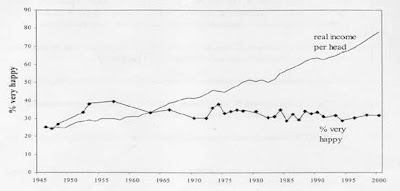
The graph below shows there is no direct relationship between proportion of people reporting themselves to be very happy and growth in GDP.


Two things explain the Paradox. Firstly, recalling my last post, I argued we are an envious bunch- every pound you earn makes me worse off, you wicked swine. So whilst we all get richer, we all get miserable at each other's wealth- offsetting the benefits of higher growth. Whilst the amount of material goods we can produce is potentially huge, the actual good that creates happiness is status- which is in fixed supply (only one dog can be the top dog, so if its being top dog that makes people happy, we have a problem)

Secondly, something called habituation.
Habituation is the process through which individuals adapt to new situations by changing their expectations. This adaptation implies that higher incomes are accompanied by rising expectations, such that higher incomes lead to only temporary or small increases in well-being. The evidence for this process is widespread. For example, Clark (1999) finds that job satisfaction in the UK is unaffected by the level of wages, and depends only on their rate of change- implying a strong negative effect of habituation coming from the lagged wage.

Taken together, income rivalry and habituation can explain why economic growth is not increasing the proportion of people who report themselves to be very happy.
These phenomena represent powerful challenges to economic orthodoxy.

Neoclassic stalwarts will complain:
i) you can't measure an individual's happiness
ii) you can't compare people's happiness (inter-personal comparisons are impossible)
iii) happiness economics sounds like something studied by sociologists, and sociologists should be ignored

I leave my response to the Neoclassic critique to a later post (you lucky things).

Why do you want to be Rich?

Imagine I offer you the choice between living in one of two worlds, A or B:

A: you earn £50k, and others earn £25k

B: you earn £100k, and others earn £250k

In which world would you prefer to live?

I'm guessing that many of you will have chosen world A (or at least been very tempted to do so), despite the fact that you get 50% less cash than in world B. Indeed when Solnick and Hemenway (1998) first conducted this test with a group of Harvard graduates they found that half of respondents chose World A. (Read summary here)

What does this survey tell us? Well, it implies something that it is fairly obvious but which economist's seldom incorporate into their models: what people really care about is their income relative to other people's, rather than their absolute level of income per se.


The way in which we are envious of other people's income has begun to be more systematically examined. For example Blanchflower and Oswald (2004) use a large panel data set to estimate the impact of other people's income on an individual's self-reported happiness. They find that the negative effect on happiness of other people's income is about 30% of the positive effect of own income. That is, if your neighbour earns an extra £1, this event decreases your happiness by the same extent as a fall in your own income of 30p.

So to answer the question posed as the title of this Blog entry- my hypothesis is that a big part of the reason you want to be rich is not because you want to enjoy consuming goods in and of themselves (as standard economic theory suggests), but because you want to have more stuff than your mates- so you can parade around feeling like the big man.

As J.S Mill once wrote: Men do not desire to be rich, but to be richer than other men

Letter from Turkey

Turkey is preparing to publish a document that represents a revolutionary reinterpretation of Islam - and a controversial and radical modernisation of the religion.

The country's powerful Department of Religious Affairs has commissioned a team of theologians at Ankara University to carry out a fundamental revision of the Hadith, the second most sacred text in Islam after the Koran.

The Turkish state has come to see the Hadith as having an often negative influence on a society it is in a hurry to modernise, and believes it responsible for obscuring the original values of Islam.

Its supporters say the spirit of logic and reason inherent in Islam at its foundation 1,400 years ago are being rediscovered. Some believe it could represent the beginning of a reformation in the religion.

According to Fadi Hakura, an expert on Turkey from Chatham House in London, Turkey is doing nothing less than recreating Islam - changing it from a religion whose rules must be obeyed, to one designed to serve the needs of people in a modern secular democracy.

Significantly, the "Ankara School" of theologians working on the new Hadith have been using Western critical techniques and philosophy.


It's a very interesting development. The Enlightenment did not kill Christianity, but it softened it up and increased its separation from politics.

And as anyone who has looked at religion carefully knows, the tails are affected by the mid-region of the distribution.

Monday, 25 February 2008

Another mystery guest-blogger

Look out, he should be making his appearance soon.

And no, datacharmer is not authoring the Friday Special.

Stranger than fiction

What a beautiful film. In the best tradition of American movie-making, the story is incredibly good and the casting inspired. It even gets brownie points for being chick-friendly.